How to Reduce PDF File Size: 7 Proven Methods That Actually Work
PDFs too large to email? Learn 7 proven methods to compress PDF files while maintaining quality for professional documents.
Why PDF Files Get So Large
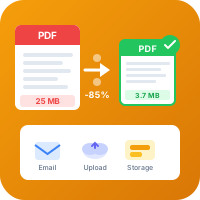
PDFs can balloon in size for several reasons:
- High-resolution images: The biggest culprit
- Embedded fonts: Each font adds to file size
- Vector graphics: Complex illustrations
- Metadata and attachments: Hidden bloat
- Creation method: Some tools create inefficient PDFs
Method 1: Online PDF Compressors
The quickest solution for occasional needs.
How to use ToolPop PDF Compressor:
- Upload your PDF
- Choose compression level
- Download compressed file
Compression Levels Explained
| Level | Quality | Size Reduction | Best For |
|---|---|---|---|
| Low | Maximum | 20-40% | Archiving |
| Medium | Balanced | 40-60% | General use |
| High | Reduced | 60-80% | Email, web |
Method 2: Reduce Image Quality in Source
If you create the PDF yourself, optimize before converting.
Before Creating PDF:
- Resize images to needed dimensions
- Compress images (JPEG: 70-80%, PNG: use WebP)
- Use appropriate resolution (150 DPI for screen, 300 for print)
Image Resolution Guide
| Use Case | Resolution | Notes |
|---|---|---|
| Screen viewing | 72-150 DPI | Sufficient for displays |
| Standard printing | 300 DPI | General documents |
| High-quality print | 300-600 DPI | Only when necessary |
Method 3: Use "Reduce File Size" in PDF Software
Most PDF editors have built-in compression.
Adobe Acrobat:
- File → Save As Other → Reduced Size PDF
- Choose compatibility (newer = smaller)
- Save
Preview (Mac):
- File → Export
- Quartz Filter → Reduce File Size
- Save
Method 4: Remove Unnecessary Elements
Hidden elements add size without value.
What to Remove:
- Embedded fonts: Convert to outlines if not editable
- Metadata: Document properties, author info
- Comments and annotations: If not needed
- Form fields: Flatten if forms are complete
- Hidden layers: Often forgotten
- Bookmarks: Remove if unused
Using Adobe Acrobat:
- Tools → Optimize PDF
- Audit space usage
- Remove unnecessary elements
- Save
Method 5: Print to PDF with Lower Quality
Re-printing can reduce size.
Windows:
- Open PDF in any viewer
- Print → Microsoft Print to PDF
- Choose lower DPI in preferences
Mac:
- Open PDF in Preview
- File → Print → PDF → Save as PDF
- Quartz Filter → Reduce File Size
Method 6: Split Large PDFs
Sometimes smaller files are the solution.
When to Split:
- Email attachment limits (25MB for Gmail)
- Upload restrictions
- Sharing specific sections
Using ToolPop PDF Splitter:
- Upload your PDF
- Choose split method (pages, size, bookmarks)
- Download parts
Method 7: Convert to PDF/A
PDF/A is an archival format that's often smaller.
Benefits:
- Embedded fonts subset (only used characters)
- Optimized structure
- Long-term compatibility
- Often smaller than original
How to Convert:
Most PDF editors offer PDF/A export. Choose PDF/A-1b for maximum compatibility.
Comparison of Methods
| Method | Effort | Quality Loss | Size Reduction |
|---|---|---|---|
| Online compressor | Low | Minimal-Moderate | 20-80% |
| Source optimization | Medium | None | 30-70% |
| PDF software | Low | Minimal | 20-50% |
| Remove elements | Medium | None | 10-40% |
| Print to PDF | Low | Possible | 20-60% |
| Split PDF | Low | None | N/A |
| Convert to PDF/A | Low | None | 10-30% |
Quality vs Size Trade-offs
When Quality Matters:
- Legal documents
- Print materials
- Archival purposes
- Client deliverables
When Size Matters:
- Email attachments
- Web uploads
- Internal sharing
- Storage limits
Batch Compression
For multiple PDFs, use command-line tools.
Using Ghostscript:
gs -sDEVICE=pdfwrite -dCompatibilityLevel=1.4 \
   -dPDFSETTINGS=/ebook \
   -dNOPAUSE -dBATCH \
   -sOutputFile=output.pdf input.pdf
Settings options:
- /screen: 72 DPI (smallest)
- /ebook: 150 DPI (good balance)
- /printer: 300 DPI (print quality)
- /prepress: 300 DPI (high quality)
Common Mistakes
- Over-compressing: Check quality before sending
- Losing text: Some compression rasterizes text
- Breaking links: Interactivity may be lost
- Forgetting originals: Keep uncompressed backups
- Wrong format: Sometimes image format is better (for single-page visuals)
Quick Decision Guide
Need to email a PDF? → Use online compressor at medium quality
Creating a new PDF? → Optimize images before creating
Have Adobe Acrobat? → Use Optimize PDF tool
Large PDF for web? → Consider splitting into chapters
Archiving documents? → Convert to PDF/A
Conclusion
PDF compression doesn't have to sacrifice quality. By understanding why PDFs get large and choosing the right method, you can reduce file sizes by 50-80% while maintaining professional appearance.
Start with ToolPop's free PDF Compressor for quick results, then apply these techniques for creating smaller PDFs from the start.
Try Our Free Tools
Put these tips into practice with our free online tools. No signup required.
Explore Tools