The Ultimate Guide to Image Compression for the Web in 2025
Slow websites lose visitors. Learn the art and science of image compression to speed up your site without sacrificing visual quality.
Why Image Compression Matters in 2025
In an era where user attention spans are measured in seconds, website speed is no longer optional,it's essential. Images account for over 50% of the average webpage's total size, making image compression one of the most impactful optimizations you can make.
The Cost of Unoptimized Images
- 53% of mobile users abandon sites that take longer than 3 seconds to load
- Every 100ms delay in load time can reduce conversions by 7%
- Google considers page speed a ranking factor for both desktop and mobile searches
Understanding Image Compression
Image compression reduces file size by eliminating redundant data. There are two main types:
Lossy Compression
Lossy compression permanently removes some image data to achieve smaller file sizes. This is ideal for photographs and complex images where minor quality loss is imperceptible.
Best for: JPEG images, photographs, detailed graphics Typical savings: 60-90% reduction in file size
Lossless Compression
Lossless compression reduces file size without any quality loss. The original image can be perfectly reconstructed from the compressed file.
Best for: PNG images, graphics with text, screenshots Typical savings: 10-50% reduction in file size
Choosing the Right Format
JPEG
- Best for photographs and complex images
- Supports lossy compression
- No transparency support
- Recommended quality: 70-85%
PNG
- Best for graphics, logos, and screenshots
- Supports lossless compression
- Supports transparency
- Larger file sizes than JPEG
WebP
- Modern format with superior compression
- Supports both lossy and lossless
- Supports transparency and animation
- 25-35% smaller than JPEG at equivalent quality
- Supported by all modern browsers
AVIF
- Next-generation format
- Even better compression than WebP
- Growing browser support
- Best for future-proofing
Step-by-Step Compression Workflow
1. Choose the Right Dimensions
Before compressing, resize your images to the actual display size needed:
- Don't upload a 4000x3000 image for a 800x600 container
- Use responsive images with srcset for different screen sizes
- Consider 2x resolution for retina displays
2. Select Optimal Format
Use our decision matrix:
| Content Type | Recommended Format |
|---|---|
| Photographs | WebP (fallback: JPEG) |
| Screenshots | PNG or WebP |
| Logos | SVG or PNG |
| Icons | SVG |
| Animated | WebP or GIF |
3. Apply Compression
For photographs (JPEG/WebP):
- Start at 80% quality
- Reduce until artifacts become visible
- Back off slightly for optimal balance
- Use lossless compression
- Reduce color palette if possible
- Consider indexed color (PNG-8) for simple graphics
4. Verify Results
Always check your compressed images at 100% zoom to ensure quality is acceptable. Pay attention to:
- Text legibility
- Edge sharpness
- Color accuracy
- Compression artifacts
Advanced Techniques
Lazy Loading
Implement lazy loading to defer off-screen images:
<img src="image.webp" loading="lazy" alt="Description">Responsive Images
Serve appropriately sized images for each viewport:
<img
  srcset="image-400.webp 400w,
          image-800.webp 800w,
          image-1200.webp 1200w"
  sizes="(max-width: 600px) 400px,
         (max-width: 1200px) 800px,
         1200px"
  src="image-800.webp"
  alt="Description">
Content Delivery Networks (CDN)
Use a CDN to serve images from servers closest to your users. Many CDNs also offer automatic image optimization.
Measuring Success
Track these metrics before and after optimization:
- Largest Contentful Paint (LCP): Should be under 2.5 seconds
- Total page weight: Aim for under 1MB for images
- Time to First Byte (TTFB): CDN can improve this
- Core Web Vitals score: Check in Google Search Console
Common Mistakes to Avoid
- Over-compressing: Quality settings below 60% often create visible artifacts
- Wrong format: Using PNG for photographs wastes bandwidth
- Ignoring dimensions: Serving oversized images that get scaled down
- No fallbacks: Not providing JPEG/PNG fallback for older browsers
- Forgetting mobile: Not optimizing for smaller screens
Tools and Resources
ToolPop Image Tools
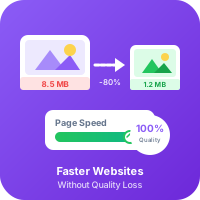
- Image Compressor: Reduce image size by up to 80%
- Image Resizer: Resize images to exact dimensions
- Format Converter: Convert between JPEG, PNG, WebP
Testing Tools
- Google PageSpeed Insights
- GTmetrix
- WebPageTest
- Lighthouse in Chrome DevTools
Conclusion
Image optimization is one of the highest-impact performance improvements you can make. By following this guide,choosing the right format, applying appropriate compression, and implementing modern techniques like lazy loading and responsive images,you can dramatically improve your website's speed and user experience.
Start by analyzing your current images with PageSpeed Insights, then use ToolPop's free tools to compress and optimize them. Your users (and search rankings) will thank you.

Try Our Free Tools
Put these tips into practice with our free online tools. No signup required.
Explore Tools