WebP Image Format: Complete Guide for Web Developers
WebP offers 25-35% smaller file sizes than JPEG with equivalent quality. Learn everything about this modern image format and how to use it effectively.
What is WebP?
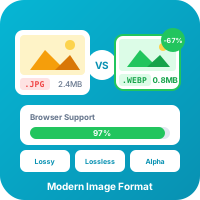
WebP is a modern image format developed by Google that provides superior compression for images on the web. It supports both lossy and lossless compression, as well as animation and transparency.
Key Advantages
- 25-35% smaller than JPEG at equivalent quality
- 26% smaller than PNG for lossless images
- Supports transparency (like PNG)
- Supports animation (like GIF, but smaller)
- Excellent browser support (97%+ globally)
WebP vs Other Formats
WebP vs JPEG
| Feature | WebP | JPEG |
|---|---|---|
| File Size | 25-35% smaller | Baseline |
| Transparency | Yes | No |
| Animation | Yes | No |
| Lossy Quality | Excellent | Good |
| Browser Support | 97%+ | 100% |
WebP vs PNG
| Feature | WebP | PNG |
|---|---|---|
| Lossless Size | 26% smaller | Baseline |
| Lossy Option | Yes | No |
| Transparency | Yes | Yes |
| Animation | Yes | APNG only |
WebP vs GIF
| Feature | WebP | GIF |
|---|---|---|
| Animation File Size | 64% smaller | Baseline |
| Color Depth | 24-bit | 8-bit (256 colors) |
| Transparency | Full alpha | 1-bit |
Browser Support
As of 2025, WebP is supported by:
- Chrome (from version 17)
- Firefox (from version 65)
- Safari (from version 14)
- Edge (from version 18)
- Opera (from version 11.5)
For the remaining ~3%, you should provide fallbacks.
Converting Images to WebP
Using ToolPop
- Go to JPG to WebP or PNG to WebP converter
- Upload your image
- Adjust quality settings (recommended: 80-85%)
- Download your WebP file
Using Command Line (cwebp)
# Install (macOS)
brew install webp

# Convert JPEG to WebP
cwebp -q 80 input.jpg -o output.webp

# Convert PNG to WebP (lossless)
cwebp -lossless input.png -o output.webp
Using Build Tools
Webpack (imagemin-webp-webpack-plugin):
const ImageminWebpWebpackPlugin = require('imagemin-webp-webpack-plugin');

module.exports = {
  plugins: [
    new ImageminWebpWebpackPlugin({
      config: [{
        test: /\.(jpe?g|png)/,
        options: { quality: 80 }
      }]
    })
  ]
};
Implementing WebP with Fallbacks
Using the Picture Element
The most reliable method for serving WebP with fallbacks:
<picture>
  <source srcset="image.webp" type="image/webp">
  <source srcset="image.jpg" type="image/jpeg">
  <img src="image.jpg" alt="Description">
</picture>
Using CSS Background Images
For CSS backgrounds, use feature detection:
/* Default fallback */
.hero {
  background-image: url('hero.jpg');
}

/* WebP for supported browsers */
.webp .hero {
  background-image: url('hero.webp');
}
Add Modernizr or this JavaScript for detection:
async function checkWebP() {
  const webP = new Image();
  webP.src = 'data:image/webp;base64,UklGRjoAAABXRUJQVlA4IC4AAACyAgCdASoCAAIALmk0mk0iIiIiIgBoSygABc6WWgAA/veff/0PP8bA//LwYAAA';
  await webP.decode();
  document.documentElement.classList.add('webp');
}
checkWebP().catch(() => {});
Server-Side Content Negotiation
Configure your server to serve WebP automatically:
Nginx:
map $http_accept $webp_suffix {
  default "";
  "~*webp" ".webp";
}

location ~* ^(.+)\.(png|jpe?g)$ {
  add_header Vary Accept;
  try_files $1$webp_suffix $uri =404;
}
Apache (.htaccess):
<IfModule mod_rewrite.c>
  RewriteEngine On
  RewriteCond %{HTTP_ACCEPT} image/webp
  RewriteCond %{REQUEST_FILENAME}.webp -f
  RewriteRule ^(.+)\.(jpe?g|png)$ $1.webp [T=image/webp,E=webp:1,L]
</IfModule>
Quality Settings
Lossy WebP
Recommended quality settings:
| Use Case | Quality | Notes |
|---|---|---|
| Thumbnails | 60-70 | Small display size hides artifacts |
| General photos | 75-85 | Best balance |
| High quality | 85-90 | Minimal quality loss |
| Near-lossless | 95-100 | Maximum quality |
Lossless WebP
Use for:
- Screenshots with text
- Graphics with sharp edges
- Images that will be edited further
- When file size increase is acceptable
Advanced WebP Features
Animated WebP
WebP animations are significantly smaller than GIF:
# Convert GIF to animated WebP
gif2webp -q 80 input.gif -o output.webp
Near-Lossless Mode
A middle ground between lossy and lossless:
cwebp -near_lossless 60 input.png -o output.webpAlpha Compression
For images with transparency:
# Lossy RGB, lossless alpha
cwebp -q 80 -alpha_q 100 input.png -o output.webp
Common Issues and Solutions
Issue: Colors look different
Cause: Color profile handling Solution: Convert to sRGB before WebP conversion
Issue: Artifacts on text
Cause: Lossy compression on sharp edges Solution: Use lossless mode or higher quality (90+)
Issue: Large WebP files
Cause: Wrong settings for content type Solution:
- Use lossy for photos
- Reduce quality to 75-80%
- Resize to actual display size
Measuring WebP Benefits
Track these metrics:
- File size reduction: Compare original vs WebP
- Page load time: Measure with WebPageTest
- LCP improvement: Check Core Web Vitals
- Bandwidth savings: Monitor CDN analytics
Future: WebP and Beyond
While WebP is excellent, newer formats are emerging:
- AVIF: Even better compression (20% smaller than WebP)
- JPEG XL: Excellent quality, royalty-free
Conclusion
WebP is a must-use format for web developers in 2025. With near-universal browser support, excellent compression, and versatile features, there's no reason not to use it.
Start by converting your largest images using ToolPop's free converters, implement proper fallbacks, and watch your page load times improve.
Try Our Free Tools
Put these tips into practice with our free online tools. No signup required.
Explore Tools