
Word to PDF Conversion: Best Practices for Perfect Document Formatting
Converting Word to PDF seems simple, but maintaining perfect formatting requires knowledge. Learn the best practices for professional results.
Why Convert Word to PDF?
Microsoft Word documents are great for creation and editing, but PDFs are the gold standard for sharing and distribution. Converting Word to PDF offers numerous advantages.
Benefits of PDF Over Word
Universal Compatibility
- Opens on any device without Word
- Consistent viewing across platforms
- No software version issues
- Works on Windows, Mac, Linux, mobile
- Layout remains exactly as designed
- Fonts display correctly everywhere
- Images stay in position
- Tables maintain structure
- Industry standard for business documents
- Clean, polished presentation
- Suitable for legal documents
- Ready for printing
- Password protection available
- Restrict printing, copying, editing
- Digital signatures support
- Document integrity assurance
When to Use Word vs. PDF
| Purpose | Use Word | Use PDF |
|---|---|---|
| Editing | Yes | No |
| Collaboration | Yes | Limited |
| Distribution | No | Yes |
| Archival | No | Yes |
| Printing | Either | Preferred |
| Email attachments | No | Yes |
| Legal documents | No | Yes |
| Web publishing | No | Yes |
Preparing Your Word Document
Before converting, optimize your Word document for the best PDF output.
Check Document Formatting
Page Setup
- Verify margins are correct
- Confirm page size (A4, Letter, etc.)
- Check orientation (portrait/landscape)
- Review header and footer placement
- Use common fonts when possible
- Embed unusual fonts in Word
- Check font substitutions
- Verify special characters display correctly
- Use high-resolution images (300 DPI for print)
- Check image placement and sizing
- Verify image compression settings
- Test transparency effects
Common Formatting Elements
Headers and Footers
Before conversion, verify:
- Page numbers display correctly
- Company logos are high quality
- Header/footer content is complete
- Different first page settings work
Tables
Check that:
- Cell borders display properly
- Text alignment is correct
- Tables don't break awkwardly across pages
- Column widths are appropriate
Images and Graphics
Ensure:
- Images are not blurry
- Charts/graphs are readable
- Clip art converts cleanly
- SmartArt renders correctly
Handling Fonts
Safe Font Choices These fonts are available on most systems:
| Font Family | Use Case |
|---|---|
| Arial | General purpose |
| Times New Roman | Formal documents |
| Calibri | Modern look |
| Georgia | Easy reading |
| Verdana | Screen reading |
| Courier New | Code/monospace |
- Go to File > Options > Save
- Enable "Embed fonts in the file"
- Choose "Embed all characters"
- Save and convert
- Install fonts on conversion machine
- Convert text to outlines (for logos)
- Use web-safe alternatives
- Embed fonts before converting
Converting Word to PDF
Using ToolPop's Word to PDF Converter
Step 1: Upload Your Document
- Click "Upload" or drag and drop
- Supports .doc and .docx formats
- Maximum file size: 50 MB
- Page size selection
- Quality options
- Compatibility level
- Click "Convert to PDF"
- Review the output
- Download your PDF
Conversion Options Explained
PDF/A Compliance
- Long-term archival format
- Self-contained (all fonts embedded)
- No external dependencies
- Required for some legal/government uses
- Smaller file sizes
- More flexibility
- Suitable for most uses
- Better for web distribution
| Setting | DPI | Best For |
|---|---|---|
| Screen | 72 | Email, web viewing |
| Standard | 150 | General use |
| High | 300 | Professional printing |
| Press | 300+ | Commercial printing |
Troubleshooting Common Issues
Fonts Not Displaying Correctly
Problem: Text looks different in PDF
Solutions:
- Embed fonts in Word before converting
- Use standard system fonts
- Install required fonts on the system
- Convert text to curves/outlines for logos
- Always use embedded fonts for custom typefaces
- Test conversion before final distribution
- Include font files with source documents
Images Appear Blurry
Problem: Photos and graphics lose quality
Solutions:
- Use original high-resolution images
- Avoid excessive compression in Word
- Select higher quality conversion settings
- Reinsert images at native resolution
For screen viewing: 72-150 DPI
For office printing: 150-200 DPI
For professional printing: 300+ DPI
Layout Shifts
Problem: Elements move from their positions
Solutions:
- Use fixed positioning in Word
- Group related elements
- Check page margins match
- Verify page size settings
- Lock anchor positions for images
- Use tables for complex layouts
- Set exact measurements, not relative
- Test on different page sizes
Tables Break Incorrectly
Problem: Tables split awkwardly across pages
Solutions:
- Enable "Keep with next" for table headers
- Set "Repeat header rows" option
- Reduce table size if necessary
- Allow rows to break across pages
Hyperlinks Not Working
Problem: Links in PDF don't open
Solutions:
- Ensure links are properly formatted in Word
- Use full URLs (including https://)
- Test links after conversion
- Check PDF security settings
Color Changes
Problem: Colors look different in PDF
Solutions:
- Use RGB color mode for screen viewing
- Use CMYK for print production
- Avoid system-dependent colors
- Test on multiple displays
Advanced Conversion Techniques
Creating Bookmarks and Navigation
From Word Headings:
- Use built-in heading styles (Heading 1, 2, 3)
- Enable "Create bookmarks from headings"
- Bookmarks will appear in PDF navigation
- Add bookmarks in Word
- Export with bookmark preservation
- Verify in PDF reader
Creating Fillable Forms
Convert Word forms to PDF forms:
- Design form in Word with content controls
- Convert to PDF
- Add form fields in PDF editor
- Test form functionality
- Simple forms convert better
- Complex layouts may need adjustment
- Test on various PDF readers
- Consider using PDF form tools directly
Adding Security During Conversion
Password Protection:
- Set password to open document
- Set password to edit/print
- Choose encryption level
Options include:
- Prevent printing
- Prevent copying text
- Prevent editing
- Prevent extracting pages
Batch Conversion
When converting multiple documents:
- Organize source files in one folder
- Use consistent settings for all
- Process in batches of 10-20
- Verify samples before full batch
- Name output files systematically
Best Practices Summary
Before Conversion
- [ ] Spell check and proofread
- [ ] Verify all formatting
- [ ] Check page numbers
- [ ] Embed custom fonts
- [ ] Optimize images
- [ ] Test print preview
- [ ] Remove track changes
- [ ] Check document properties
During Conversion
- [ ] Select appropriate quality
- [ ] Choose correct page size
- [ ] Enable bookmarks if needed
- [ ] Set security options
- [ ] Verify compatibility level
After Conversion
- [ ] Open PDF and review
- [ ] Check all pages
- [ ] Test hyperlinks
- [ ] Verify fonts display
- [ ] Check image quality
- [ ] Test on different devices
- [ ] Confirm file size is acceptable
Industry-Specific Considerations
Legal Documents
- Use PDF/A format for long-term validity
- Embed all fonts
- Add digital signatures if required
- Include proper metadata
- Maintain version control
Business Reports
- Include interactive table of contents
- Add bookmarks for navigation
- Optimize for email sharing
- Consider print and screen versions
Academic Papers
- Follow submission guidelines exactly
- Verify font embedding
- Check figure and table placement
- Include proper citations formatting
Marketing Materials
- Use high-quality images
- Maintain brand color accuracy
- Test on multiple devices
- Consider file size for distribution
Conclusion
Converting Word to PDF is straightforward when you follow best practices. Proper preparation, attention to formatting, and quality verification ensure professional results every time.
Key Takeaways
- Prepare your document: Check formatting before converting
- Use appropriate settings: Match quality to purpose
- Embed fonts: Ensure consistent display everywhere
- Test thoroughly: Verify output before distribution
- Consider your audience: Optimize for how it will be viewed
Quick Checklist
| Step | Action |
|---|---|
| 1 | Review formatting in Word |
| 2 | Embed custom fonts |
| 3 | Check image quality |
| 4 | Choose conversion settings |
| 5 | Convert to PDF |
| 6 | Verify output |
| 7 | Distribute |
Related Articles
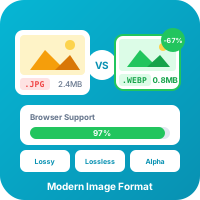
WebP Image Format: Complete Guide for Web Developers
WebP offers 25-35% smaller file sizes than JPEG with equivalent quality. Learn everything about this modern image format and how to use it effectively.
Read more
JSON Formatting and Validation: A Developer's Complete Guide
JSON is everywhere in modern development. Learn how to format, validate, and debug JSON data like a pro with this comprehensive guide.
Read moreTry Our Free Tools
Put these tips into practice with our free online tools. No signup required.
Explore Tools